
Healthcare marketing connects clinical expertise with the trust, access, and clarity patients need before choosing care. This guide explains how to build a strategy that supports ethical growth and measurable patient acquisition.
Quick answer
Healthcare marketing is the disciplined use of communication, digital channels, relationships, and patient experience design to help people find, understand, and choose appropriate care. Effective healthcare marketing combines a clear value proposition with accessible journeys, compliant data practices, useful content, and measurement tied to organizational goals. For clinics and health professionals, the strongest strategy is not simply more visibility. It is a connected system that turns relevant attention into qualified inquiries, completed appointments, positive experiences, and long term trust.
Summary
Treat healthcare marketing as a patient experience system, not just an advertising function.
Build the five P's around a clear service offer, accessible pricing, convenient access, useful promotion, and accountable people.
Use CRM, CMS, automation, analytics, and engagement data as a connected measurement system.
Prioritize consent, privacy, reviews, quality evidence, and helpful personalization as trust signals.
In 2026, AI assisted discovery, connected video, data unification, and conversion attribution deserve close attention.

What is Healthcare Marketing?
Healthcare marketing is the planned communication and growth activity used by healthcare professionals, clinics, hospitals, specialized centers, and public health organizations to influence decisions that can benefit an audience’s physical or mental health. It includes positioning, content, search, paid media, referrals, partnerships, patient experience, and measurement, all shaped by privacy and ethical responsibilities.
Healthcare marketing is broader than promotion. It begins with understanding what a patient needs, continues through discovery and evaluation, and extends into scheduling, communication, care access, follow up, and reputation. A campaign may attract attention, but the complete marketing system must help a person move from uncertainty to an informed next step.
Health care marketing is designed to influence behavior when the benefits accrue to the target audience’s physical or mental health. It may be carried out by individual professionals, hospitals, clinics, or national agencies such as the National Cancer Institute. That definition matters because it places usefulness and public responsibility alongside commercial performance.
For a medical practice, the practical question is not simply how to get more clicks. It is how to make the right service understandable to the right audience, in a way that respects clinical boundaries and makes access easier. A primary care practice, a physical therapy clinic, a radiology center, and a mental health provider may therefore need different messages, journeys, and conversion signals.
Natto USA Agency views healthcare marketing as the connection between digital visibility, strategic relationships, business development, and sustainable growth. In that view, content and advertising are important, but they work best when the brand promise, patient journey, referral network, and commercial process reinforce one another.

Why is Healthcare Marketing Important?
Healthcare marketing matters because patients increasingly research care, compare experiences, and expect convenient communication before they contact a provider. A strong strategy helps an organization earn attention, reduce friction, compete with new care models, and connect marketing investment to patient and business outcomes.
Trust is the central asset. People often make healthcare choices while managing uncertainty, discomfort, urgency, or fear. Clear service information, credible educational content, visible quality achievements, and respectful communication can make a provider easier to evaluate. Promoting hard-won quality achievements is one of the most effective ways to build a trusting brand image, provided the claims are specific, accurate, and understandable.
The market is also more crowded. Retail clinics, virtual care providers, and other new entrants have expanded their footprint quickly. A local practice cannot assume that clinical competence alone will make it discoverable. Its marketing must explain who it serves, what problems it addresses, how access works, and why the experience deserves consideration.
Healthcare marketing also supports patient acquisition. That phrase should mean more than lead volume. The useful outcome is a qualified person who can be served, receives an appropriate response, schedules when relevant, and has a realistic path to care. This requires alignment between the promise in an ad, the information on a landing page, the intake process, and the staff member who answers the inquiry.
There are practical obstacles. Departmental silos, outdated tactics and technology, insufficient budgets, and difficulty proving return across fragmented channels can all weaken performance. Marketing teams often receive budget from upper level management, so they need a clear connection between organizational objectives, activity, and outcomes. On a modest budget, smarter prioritization matters more than attempting every channel.
Measurement creates that discipline. A WebMD Ignite report says its partners see a 7:1 return on marketing spend, but a headline result should never be treated as a universal promise. The more transferable lesson is to define the conversion, track the journey, and understand which activity contributed to it.
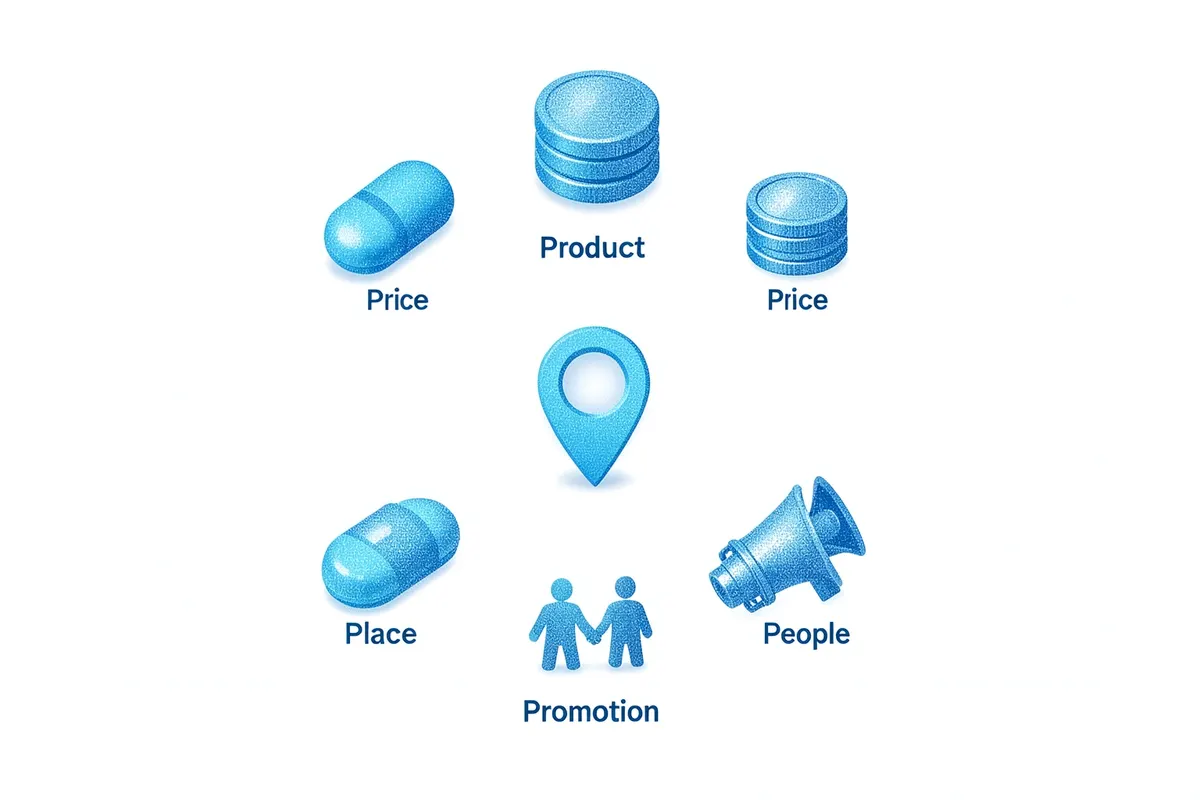
What are the 5 P's of Healthcare Marketing?
The five P's of healthcare marketing are Product, Price, Place, Promotion, and People. Together, they translate a clinical service into an understandable, accessible, and trustworthy patient proposition.
Product
Product means the care, service, expertise, and outcome pathway being offered. In healthcare, it is rarely a simple item. It can include a consultation, diagnostic service, rehabilitation program, urgent care visit, home care support, or an ongoing relationship with a clinician.
A strong product strategy clarifies the audience, need, scope, and next step. It distinguishes what the practice does from vague claims of excellence. A mental health provider might explain the types of concerns addressed and the format of care. A diagnostic center might clarify preparation, referral requirements, communication, and result delivery. The language should be clinically responsible while still being easy for a nonprofessional to understand.
Price
Price includes the financial commitment, insurance context, payment expectations, and perceived risk surrounding care. Even when a final amount depends on coverage or clinical factors, a practice can explain what patients should ask, when estimates are available, and how billing communication works.
Patients often interpret silence about cost as friction. Transparent guidance does not require oversimplification. It requires plain language, accurate boundaries, and a clear route to help. Price also includes the value of time, travel, paperwork, and uncertainty. Improving those elements can make the overall proposition more credible without competing on the lowest fee.
Place
Place is where and how care becomes available. It includes the physical location, virtual access where clinically appropriate, scheduling channels, service area, parking or transportation information, and referral pathways. Convenience is not a decorative benefit. It can determine whether interest becomes an appointment.
A place strategy should reflect the audience’s real routine. Search visibility may matter for an urgent service, while professional relationships may be more important for a specialized referral service. The best channel is the one that connects an appropriate person to a workable care pathway.
Promotion
Promotion covers the messages and channels used to create awareness, education, consideration, and action. The current mix can include organic search, paid search, social media, display, connected television, retail media, and AI assisted advertising. That breadth makes planning more important, not less.
Promotion should answer a patient’s actual questions rather than manufacture urgency. Useful formats include service pages, educational articles, videos, FAQs, local search content, referral materials, and campaigns tied to a clear next step. Reviews also matter because reading reviews is now standard behavior for people choosing a physician. Health systems should actively solicit positive reviews from satisfied patients, while following their privacy and platform responsibilities.
People
People include clinicians, front desk teams, call center staff, referral partners, marketers, and the patients whose experiences shape reputation. The fifth pillar connects the other four. A compelling service, sensible price, accessible place, and persuasive promotion can still fail when the response is slow, confusing, or impersonal.
This is why patient experience belongs inside marketing rather than after it. Staff need the context to answer questions consistently, route inquiries appropriately, and keep the brand promise grounded in actual care. For professional audiences such as law offices that work with health related organizations, the same principle applies: relationship quality and operational follow through are part of the value being marketed.

How to Build a Healthcare Marketing Strategy?
Build a healthcare marketing strategy by aligning organizational objectives with audience insight, patient experience, channel selection, compliant data use, and a measurement plan. Start with the care model and commercial reality, then choose the few activities most likely to improve qualified demand and access.
Understanding Your Target Audience
Audience research should go beyond age, location, or a broad diagnosis category. Identify the need that prompts action, the questions that delay action, the language people use, the referring professionals involved, and the practical barriers that interrupt scheduling. A practice may serve several distinct personas across service lines, each with a different reason for choosing care.
Map both patient acquisition and professional relationship pathways. A direct consumer may discover a clinic through search, while a specialized service may depend on referrals, partnerships, or an attorney network. The strategy should distinguish awareness from intent and education from conversion, rather than sending every audience to the same message.
Use interviews, call recordings where lawful, intake feedback, search behavior, reviews, and CRM data to find recurring patterns. A business intelligence solution can reveal influential channels by geography, persona, and service line. Personalization has moved beyond static segmentation, so relevant content should respond to context without exposing sensitive information or making inappropriate assumptions.
Creating a Seamless Patient Experience
A high quality healthcare marketing strategy pays attention to patient experience from start to finish. That means the promise in the ad should match the landing page, the form should request only what is necessary, the scheduling path should be understandable, and follow up should not leave the person wondering what happens next.
Audit the journey as a patient would experience it. Test mobile pages, contact routes, appointment requests, confirmation messages, directions, insurance explanations, and handoffs between marketing and intake. Then examine the human moments. A fast response with no useful answer is not seamless, and a polished website cannot compensate for an inaccessible appointment process.
Convenience and personalization motivate today’s consumers and patients. Still, healthcare personalization requires restraint. Remarketing demands more care than it once did, and regulatory scrutiny of tracking technologies has increased sharply. Tracking technologies on pages tied to health information can create real compliance risk. Legal, privacy, and clinical stakeholders should therefore review data collection, consent, audience construction, and retention practices before activation.
Utilizing Digital Marketing Tools
Digital tools should serve the strategy rather than become the strategy. A CRM platform integrates patient data from many sources so marketers can build, launch, optimize, and measure multichannel campaigns. A CMS streamlines and classifies content, while integration with the CRM helps keep future content aligned with brand guidelines. A marketing automation platform distributes content to the right individuals at the right time, and an engagement center supports personalized inbound and outbound calls.
The value appears when these systems share a reliable foundation. When CRM, EHR, campaign data, and engagement records feed a single source of truth, fragmented reports become a clearer view of the journey. Data unification separates leaders from organizations that can see activity but cannot explain outcomes.
Technology selection should include total cost of ownership, defined as the purchase price of an asset plus its operating costs. TCO analysis belongs in research and vendor partner selection, especially when implementation, governance, integration, training, and maintenance affect the real investment. Getting value from automation also requires at least one dedicated employee to implement and operate the tool.
Channel planning should match intent. Organic search can answer persistent questions, paid search can capture active demand, social content can build familiarity, and video can explain complex services. Predictive analytics and attribution modeling can forecast expected returns before spending begins. Every tactic should prove its return through a conversion definition that leadership understands.

How to Measure the Success of Healthcare Marketing?
Measure healthcare marketing by connecting activity to outcomes such as qualified inquiries, scheduled appointments, completed visits, referral growth, patient retention, and revenue aligned with the organization’s objectives. Use channel metrics as diagnostic evidence, not as the final definition of success.
Begin with a measurement framework. Define the business objective, the audience, the desired action, the responsible team, and the data source. A primary care practice may prioritize qualified appointment requests, while a diagnostic center may examine referral volume and completed studies. A specialty clinic may need to separate service lines so a high volume of low fit inquiries does not look like success.
Track the journey across discovery, engagement, inquiry, scheduling, attendance, and follow up. Useful measures can include qualified conversion rate, cost per qualified inquiry, appointment completion, response time, referral source, return visits, and patient feedback. The exact dashboard should reflect the care model and the information the organization can collect lawfully and reliably.
Health systems measure success through specific metrics aligned with key performance indicators and marketing return on investment. That alignment prevents a common failure: optimizing inexpensive attention while the operational team absorbs poor fit demand. It also helps leadership decide whether to improve the offer, the landing page, the intake process, the channel mix, or the reporting system.
Attribution is not a perfect story about causation. A patient may see a video, read a review, ask a friend, search again, and call directly. Predictive analytics and attribution modeling can still help forecast expected returns and compare patterns before further spending. The goal is better decisions, not false precision.
The measurement gap remains significant. An industry survey finding reported in 2026 says only 1% of healthcare marketers can connect more than half of their spend to patient conversions. That result makes data governance and closed loop reporting strategic priorities, not technical extras.

What are the Trends in Healthcare Marketing?
In 2026, healthcare marketing is being shaped by AI assisted discovery, unified data, privacy conscious personalization, video growth, connected television, and stronger pressure to prove patient conversion. The important trend is not adopting every new format, but adapting the operating model behind each one.
AI now shapes where health journeys begin. People may encounter summaries, recommendations, and answers before they visit a traditional search result. Practices should respond with accurate, well organized, clinically responsible information that demonstrates expertise without overstating outcomes. The strategic task is to become a dependable source for questions audiences genuinely ask.
The channel mix is broadening. A 2026 forecast places healthcare and pharma digital advertising at $26.2 billion, while traditional healthcare and pharma advertising is forecast at $6.9 billion. The difference does not make digital automatically superior. It shows why channel roles, audience intent, and measurement need to be defined before budget is distributed.
Video and connected television are gaining attention. The same forecast projects digital video and display budgets to grow by 70% year over year and connected television spending to rise by 60%. For healthcare brands, video can make a complex service more understandable, show the human side of access, and answer practical questions. It should not replace evidence or create emotional pressure.
AI integrated media and search spending is projected to increase by 50% year over year, while influencer marketing spending is projected to increase by 44%. In healthcare, influence must be evaluated through expertise, disclosure, audience fit, and accuracy. A recognizable voice is not a substitute for responsible information.
Data unification is the quieter trend with the greatest operational consequence. Organizations that connect campaign, patient experience, referral, and engagement signals can make more informed decisions about geography, persona, and service line. Those that keep each channel in a separate report may produce more activity without gaining more understanding.
Privacy is becoming a competitive trust issue. Consent, minimum necessary data practices, careful audience design, and thoughtful review of tracking are essential when communications relate to health information. Personalization should make a journey more relevant, never make a person feel watched.
For clinics, centers, and professionals, the next step is practical: select a clear objective, document the patient journey, choose accountable channels, and create a reporting rhythm that leads to action. Natto USA Agency recommends treating marketing execution, relationship development, lead generation, and ongoing optimization as connected parts of sustainable growth rather than isolated campaigns.
More qualified patient inquiries → Clarify your service proposition, map high intent questions, improve the inquiry path, and measure qualified conversions rather than raw traffic.
A stronger local reputation → Publish useful local service information, promote verifiable quality achievements, and create a compliant process for requesting reviews from satisfied patients.
Better performance from a modest budget → Prioritize the audience and channel with the clearest intent, then use attribution and operational data before expanding the mix.
More effective marketing technology → Unify CRM, EHR, campaign, and engagement data, calculate total cost of ownership, and assign a dedicated operator for automation.
Safer personalization → Review consent, tracking, audience rules, and data retention with the appropriate privacy and compliance stakeholders before activation.
A clinic with inconsistent inquiries: Start with audience research, service positioning, landing page clarity, intake response, and qualified conversion tracking.
A specialized center dependent on referrals: Prioritize professional relationships, referral materials, service line content, and closed loop referral reporting.
A growing organization with fragmented reports: Create a shared measurement model and unify CRM, EHR, campaign, and engagement signals before adding more channels.
A practice considering AI or remarketing: Begin with privacy review, useful first party content, clear consent, and a defined business objective instead of adopting technology for novelty.
Read also
how to create a successful marketing plan for medical practices
how to choose the right healthcare SEO agency for your practice
FAQ
What is healthcare marketing?
Healthcare marketing is the ethical, strategic use of communication, digital channels, relationships, and experience design to help people find and choose appropriate care while supporting organizational objectives.
How does healthcare marketing support patient acquisition?
It connects relevant audiences with clear service information, accessible scheduling, credible proof, responsive intake, and follow up. The goal is qualified demand that can become appropriate, completed care, not simply more traffic.
What are the five P's of healthcare marketing?
The five P's are Product, Price, Place, Promotion, and People. They cover the service itself, financial expectations, access, communication, and the people who deliver and experience the brand.
Which digital channels are useful for healthcare marketing?
Organic search, paid search, social media, display, video, connected television, email, websites, referral communication, and AI assisted advertising can all have a role. Selection should follow audience intent, compliance requirements, and measurable objectives.
How can a medical practice measure marketing success?
Connect activity to qualified inquiries, appointments, completed visits, referrals, response time, retention, patient feedback, and marketing return on investment. Use channel metrics to diagnose performance rather than treating clicks as the final result.
Why is patient experience part of marketing?
The experience confirms or contradicts the promise made by marketing. Scheduling, communication, access, staff interactions, and follow up influence trust, reputation, referrals, and whether demand becomes completed care.
What privacy issues affect healthcare marketing?
Tracking and personalization can create compliance risk when pages or audiences relate to health information. Organizations should review consent, data collection, audience construction, retention, and applicable privacy obligations before activating campaigns.
What healthcare marketing trends matter in 2026?
AI assisted discovery, unified data, video, connected television, privacy conscious personalization, and stronger conversion attribution are especially important. The right priority depends on the organization’s audience, care model, capacity, and objectives.
Glossary
Patient acquisition: The process of attracting, qualifying, converting, and welcoming appropriate new patients into a care pathway.
Patient experience: The connected set of interactions a person has with a healthcare organization before, during, and after care.
CRM: A customer relationship management platform that organizes relationship and campaign data for coordinated communication and measurement.
CMS: A content management system used to create, classify, govern, and publish digital content.
Marketing automation: Technology that delivers planned communications based on audience context, timing, and defined actions.
Attribution modeling: An analytical approach for estimating how different interactions contribute to a conversion or business outcome.
Total cost of ownership: The purchase price of an asset plus the costs required to operate, maintain, integrate, and support it.
Connected television: Television content delivered through internet connected devices and measured as a digital media channel.
References
The impact of marketing strategies in healthcare systems, PMC
Healthcare marketing statistics for 2026: A comprehensive ...
Healthcare Marketers Trend Report 2026: Digital ad spend ...
The State of Healthcare Marketing in 2026: A Measurement ...


